Quick answer
In NYC, the quickest way to tell a rat from a mouse is size and droppings: a house mouse is small (3–4 inch body, big ears, a tail as long as its body) and leaves pointed, rice-grain droppings 3–6 mm long, while a Norway rat is bulky (7–10 inch body, small ears, a thick scaly tail shorter than its body) and leaves blunt, capsule-shaped droppings up to about 18 mm. It matters because the city's dominant Norway rat burrows at ground and basement level and is wary of new objects, whereas mice nest inside walls and cabinets and explore freely — so the two need different trap placement, bait, and exclusion gap sizes.
Rat or mouse? Start with size and droppings
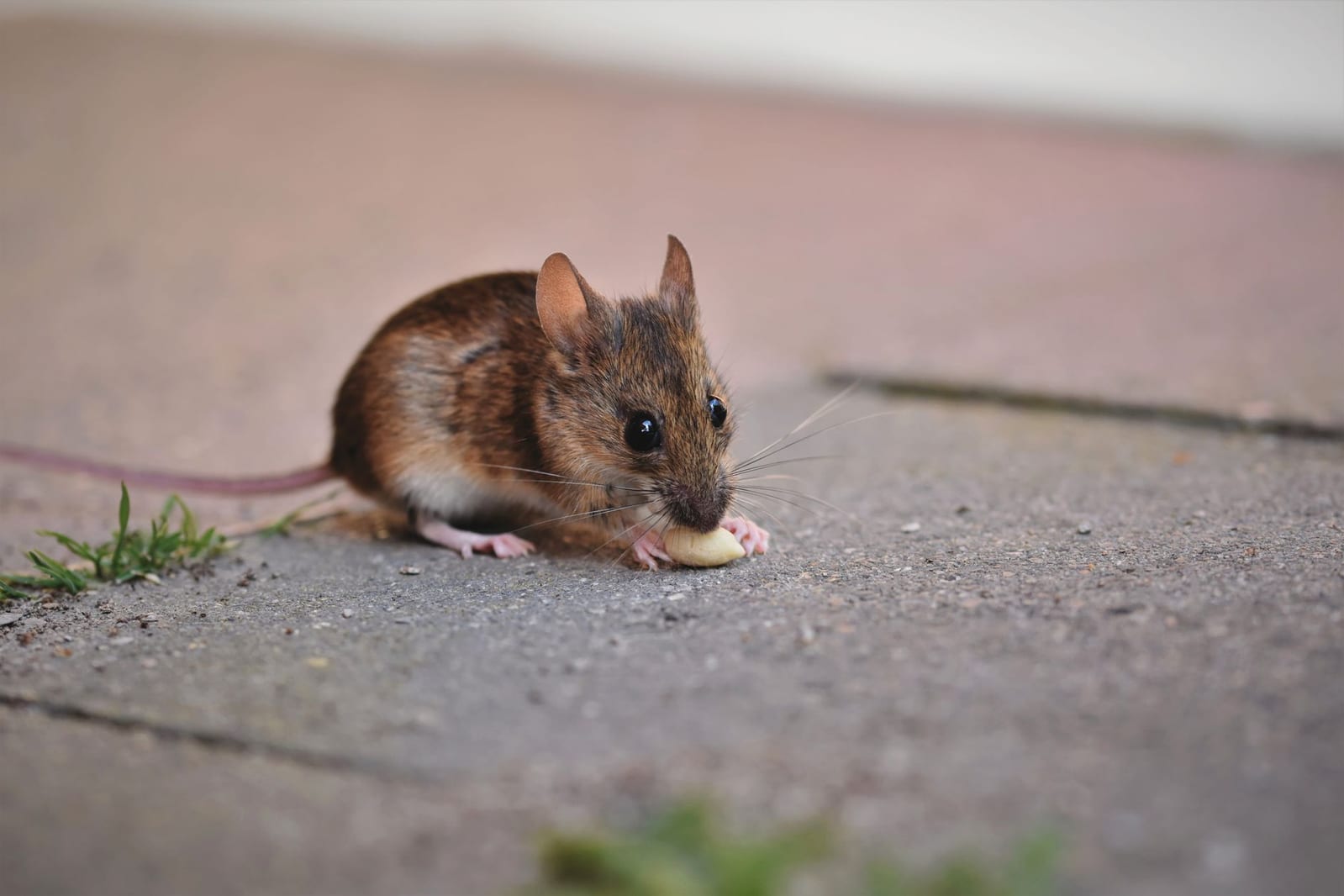
If you’ve spotted a rodent or its signs in your New York home or building, the fastest way to identify it is size and droppings. A house mouse is small — a body of about 3 to 4 inches with a thin tail roughly as long as its body, a pointed snout, and large ears for its head. A Norway rat is much bigger and heavier — a body of about 7 to 10 inches, small ears, a blunt nose, and a thick, scaly tail that is shorter than its body. Mouse droppings are tiny (3–6 mm), dark, and pointed at the ends like grains of rice. Rat droppings are far larger (up to about 18 mm), thick, and blunt or capsule-shaped at the ends. Get the ID right and everything else — trap placement, bait, gap-sealing — follows from it.
This matters in NYC more than almost anywhere. The city is estimated to host on the order of three million rats, and rat sightings drive tens of thousands of 311 complaints a year — more than 24,000 rodent-related complaints in just the first seven months of 2024 (CBS New York, NYC 311 data). Knowing which rodent you’re dealing with is the first real step toward getting rid of it. Our rat and mouse control service starts with exactly this identification, because a mouse job and a rat job look different from day one.
The species you actually have in New York
New York’s rodent picture is simpler than the general “rats vs mice” question suggests, because two species dominate.
Norway rat (brown rat / sewer rat)
Per NYC Health, the Norway rat — also called the brown rat or sewer rat — overwhelmingly dominates the city’s rat population. It is a ground-dweller. It burrows in soil near foundations, tree pits, and parks; it travels through sewers and connected basements; and it prefers the lower levels of buildings. In a brownstone or pre-war walk-up, that means the cellar, the ground-floor unit, the trash area, and the rear yard. Norway rats are strong, wary, and physically capable of gnawing through soft concrete, wood, and plastic.
House mouse
The house mouse is the other resident you’ll meet. Mice are agile climbers that nest inside the building envelope — in wall voids, behind cabinets, under appliances, and in stored clutter. They stay close to food and rarely travel more than 10 to 30 feet from the nest, which is why mouse droppings cluster in one or two rooms (typically the kitchen) rather than spreading across a property.
Roof rats — the climbing species common in warmer coastal cities — are rare in NYC, so if you have a rat in New York, assume Norway rat until proven otherwise.
Tell them apart by the evidence, not the glimpse
You’ll usually find the signs before you see the animal. Here’s how the clues differ.
Droppings
- Mouse: 3–6 mm, dark, thin, pointed at both ends, scattered like rice in drawers, cabinets, and under sinks. A single mouse can leave 50–80 droppings a day, concentrated in its small home range.
- Rat: up to about 18 mm, thick, blunt and capsule-shaped, often found along basement walls, near trash, in the yard, or by burrow openings.
Pointed and tiny means mouse; large and blunt means rat. This is the single most reliable indoor test.
Gnaw marks and damage
Mice leave small, clean gnaw marks and tend to nibble food packaging and paper. Rats leave larger, rougher gnawing and can damage baseboards, door corners, plastic pipe, and wiring. Rats also create visible burrows — two- to four-inch holes in soil, often along foundations and fence lines — which mice do not.
Grease marks and runways
Both species follow walls and leave greasy “rub marks” from oil in their fur, but rat rub marks are darker and lower (rats hug the floor along basement walls and pipe chases), while mouse smudges are fainter and higher up around cabinets and counters.
Sound and location
Scratching high in walls and ceilings or activity centered on a kitchen points to mice. Heavier scurrying low down, in the cellar, near the trash room, or in the back yard points to rats. NYC’s connected basements and shared trash areas are classic Norway-rat corridors — which is exactly why rat control in the city has to consider the whole building and block, not one apartment.
Behavior: why a rat is harder than a mouse
Identification isn’t just academic — the two species behave differently, and that changes how you trap them.
Mice are curious. They investigate new objects, including traps, within hours, so a mouse problem responds quickly to many trap and bait points placed close together (mice forage in a tight radius). The catch is reproduction: a female house mouse can have five to ten litters a year with a gestation of about three weeks (Purdue Extension), so a handful of mice becomes an infestation fast, and DIY efforts rebound when the next generation breeds.
Rats are neophobic — genuinely wary of anything new in their environment. A fresh trap or bait station can sit untouched for days before a Norway rat will approach it. Rushing the job, or moving stations around, resets that caution and makes rats harder to catch. Rat control rewards patience, correct placement along established runways, and sealing the burrows and exterior gaps they use — work that goes beyond setting a few snap traps in the kitchen.
Health stakes: both matter, rats more so in NYC
Neither rodent is harmless. Both can spread Salmonella and contaminate food and surfaces, and both should have their droppings cleaned with a bleach solution (NYC Health and the CDC recommend one part bleach to ten parts water) rather than swept or vacuumed dry, which can aerosolize particles.
Rats carry the higher-profile NYC risk. NYC Health identifies rats as the most common source of leptospirosis, a bacterial infection spread through rat urine that can cause kidney and liver damage if untreated. The city reported 24 human cases in 2023 — its highest annual total on record — and six deaths over the previous 22 years (NYC Health). That rising trend is part of why the city created Rat Mitigation Zones and appointed a citywide “rat czar,” Kathleen Corradi, to coordinate rodent reduction.
Why treatment differs — and why ID comes first
Because the species behave and live differently, the fix differs too:
- Gap size. Mice slip through a gap about a quarter inch wide — roughly a dime or pencil. Rats need a hole about the size of a quarter. Effective proofing seals both, but a mouse job means hunting down far smaller openings around pipes, vents, and door sweeps, sealed with steel wool, hardware cloth, or metal — not foam or plastic, which rodents chew through (CDC).
- Where the work happens. Mice are an interior problem — walls, cabinets, kitchens. Norway rats are a ground and exterior problem — burrows, foundations, cellars, trash areas — so rat control extends to the yard and building envelope.
- Trap and bait strategy. Mice get many stations placed close together, exploiting their curiosity. Rats get fewer, carefully placed stations on established runways, with patience for their neophobia.
This is why a correct ID is the first thing a professional confirms. Getting it wrong — treating a rat problem like a mouse problem — wastes time the population uses to grow. For the full removal playbook, see our guide to how to get rid of rats in NYC, and if you want to budget the work, rat exterminator cost in NYC breaks down what drives the price.
When to bring in a professional
If droppings appear in more than one room, you see burrows in the yard, activity is in a basement or multi-unit building, or you simply can’t tell which rodent you have, it’s time to call. In attached NYC buildings the source is often beyond your own unit — a neighbor’s wall, the shared cellar, or the block’s trash. Our rodent control team identifies the species, seals the entry points DIY misses, and coordinates building-wide treatment so the problem doesn’t just move next door.